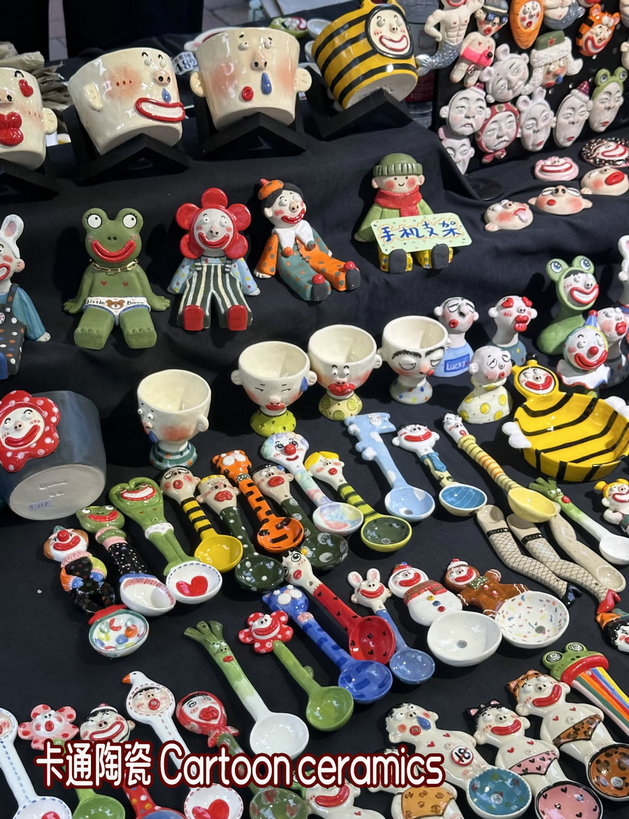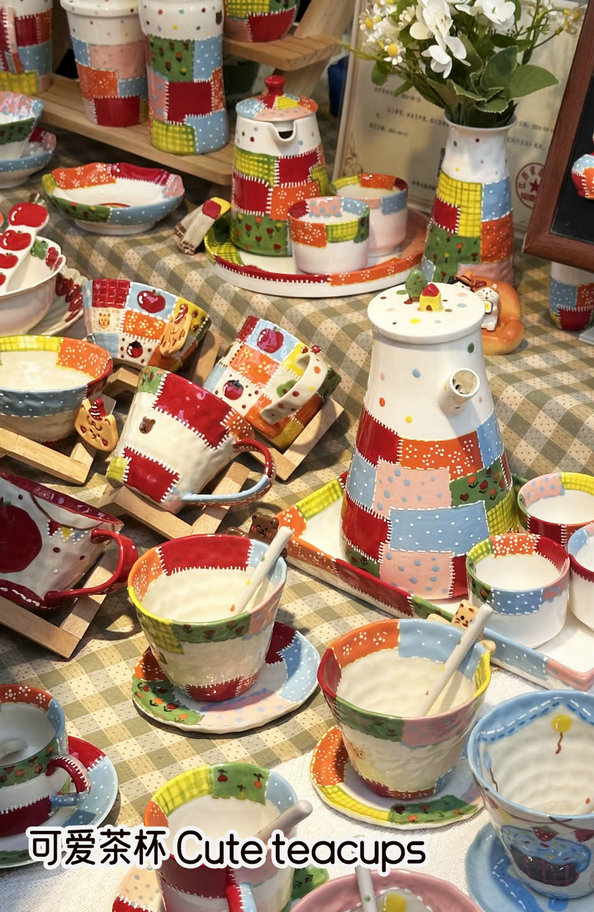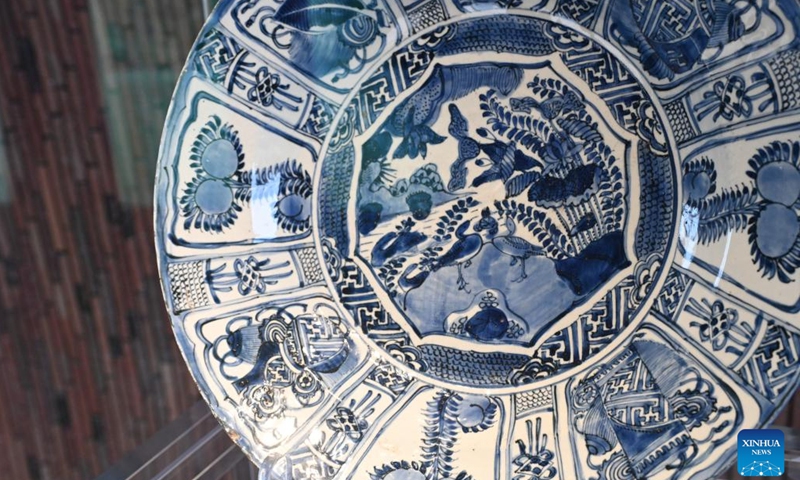
This photo shows a piece of porcelain artwork at a museum in Jingdezhen, east China's Jiangxi Province, June 5, 2024. (Photo: Xinhua)
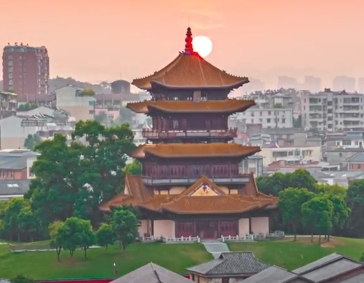
Driving along the tidy streets into Jingdezhen, Jiangxi Province, seeing the porcelain sculptures line the road, you feel the breath of history.
This is the birthplace of Chinese porcelain - a city born of fire and clay, and renowned for its beauty across the world. Its historical significance resonates with the very essence of Chinese culture and manufacturing.
Long before the age of electronics and shipping containers, Jingdezhen had already established itself as a global hub for manufacturing. Flourishing in the Tang and Song dynasties, millions of exquisite porcelain pieces were produced here, traveling across rivers and seas to Cairo, Istanbul, Lisbon, London, spreading the beauty of Chinese culture far and wide.
The influence of Chinese porcelain was so profound that in English, the word "China" came to mean both the country and the material itself. Blue-and-white bowls and pure white plates were more than commodities - they embody an ideal of perfection: a chemical miracle of reason, elegance and flame, a testament to the artistic and scientific prowess of Chinese manufacturing.
So, what does "Made in China" mean today?
The British historian Joseph Needham once wrote in Science and Civilization in China that porcelain was one of the triumphant syntheses of Chinese art, science, and industry. He also referred to Jingdezhen as "the earliest industrial city in the world." In the new century, those words still sound astonishingly fresh.
People often think of porcelain as both art and everyday items, but in Jingdezhen, it was first and foremost a science.
The science involves firing temperatures above 1,300 C, controlling the subtle interactions of flame and air - all achieved by instinct and experience. It was chemistry without thermometers, engineering without equations. Hidden in the secret of porcelain lies the technical wisdom of ancient China. This pursuit of science in the service of beauty may well be the spiritual core that modern Chinese manufacturing seeks to rediscover.
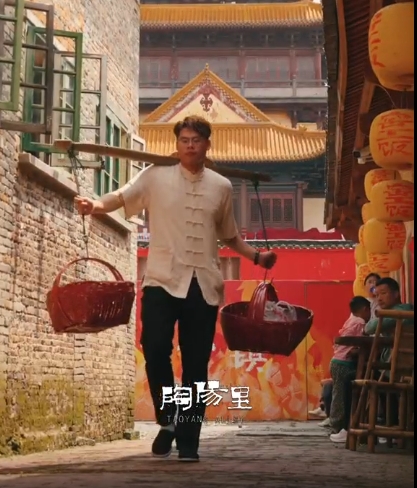
In the renovated Taoxichuan Art District, a significant part of Jingdezhen's cultural revival, the old brick walls of former factories are now filled with young creators. Their porcelain lamps fold like paper, their cups and dishes are shaped to fit modern rhythms of life.
"We're not copying relics," a guide told me, "We're listening to the past."
That sentence stayed with me - it captures the mind-set China's manufacturing most needs for its next stage: not mere replication of the past, but innovation that resonates with the spirit and beauty of Jingdezhen's craftsmanship.
For "Made in China" today, the real question is no longer whether we can make it, but whether we can create something meaningful - whether the nation can revive the deep harmony of skill, spirit and beauty that once defined its craftsmanship.
In an age dominated by artificial intelligence and robotics, people everywhere are rediscovering their longing for things that carry the warmth of human touch. Perhaps this is the lesson Jingdezhen offers to 21st century industry: When technology reconnects with culture and emotion, manufacturing becomes creation.
Modern Chinese factories are evolving at an astonishing rate. A child in Paris twisting a Rubik's cube made in China, or a young woman in Nairobi using a Chinese smartphone to talk with her family in her village - what kind of "Chinese element" will they feel in their hands?
Jingdezhen's answer is still written in clay: The value of a product lies not only in its function, but in what it shares - the curiosity for the world and a belief in harmony between human and material.
Inside the kilns, porcelain bodies glow red, cool and turn white - an everyday miracle that never seems to fade.
The story of "Made in China" has never been only about speed, scale or efficiency. It is a story of continuity - a civilization that once taught the world how to turn clay and fire into poetry is now ready to introduce how technology can return to humanity and sustainability, like a porcelain cup that has traveled through a thousand years yet still rests warm and bright in the palm of the hand.
The author is a senior editor with the People's Daily and currently a senior fellow with the Chongyang Institute for Financial Studies at Renmin University of China. dinggang@globaltimes.com.cn. Follow him on X @dinggangchina